
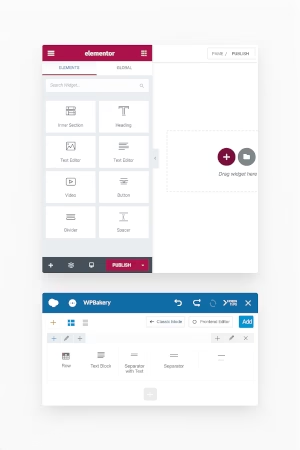
Every couple of years the WordPress world goes through a phase where everyone rediscovers the same question: is Elementor or WPBakery the better builder? And every time you think the topic is finally settled, someone insists that WPBakery still “gets the job done.” The truth is that both builders have their place, both have built thousands of websites, and both have produced headaches of different kinds for developers who had to maintain the aftermath. But if we’re talking about modern workflows, long-term maintainability, client friendliness, performance realities, and the actual day-to-day experience of building and supporting sites, the comparison is not close anymore. Elementor simply stands on different ground.
The funny thing is how people try to frame this debate. They talk about WPBakery as if it’s “just another builder” that happens to be older. They ignore the number of hours wasted inside its cramped backend interface trying to fix spacing issues that appear out of nowhere. They downplay the endless shortcode soup that remains behind when you deactivate it. They gloss over the fact that most developers only interact with WPBakery because they’ve inherited a theme from 2016 that hard-coded it into its core. And yes, you can be productive with it, but at what cost? Eventually you realize you’re spending more time fighting the page builder than building the actual page.
Elementor, on the other hand, continues to be the builder you can hand over to almost anyone without them breaking down in frustration. A normal non-technical client can sit down, take one look at the frontend interface, and immediately understand what they’re doing. Drag. Drop. Edit. Save. There’s an actual flow to the experience. You don’t need to memorize where something is. You don’t need to write custom CSS every two minutes because you can’t get 40 pixels of padding without diving into some nested settings panel hidden behind three clicks. Elementor gives you the space to work the way you naturally think about layouts.
But before we make it sound like Elementor is perfect, let’s admit one thing: a few years ago Elementor wasn’t exactly light. If you stacked too many widgets, forgot to optimise your images, and never touched the settings, you’d end up with a page heavier than it needed to be. And that criticism was fair. But while Elementor was actively improving, WPBakery stayed exactly where it was. Elementor reworked rendering, improved asset loading, introduced container-based layouts, reduced the widget footprint, and made it possible to build clean, efficient pages without dragging along a ton of unnecessary CSS. Meanwhile WPBakery… still produces the same old shortcode soup that belongs in a museum next to ancient PHP tutorials showing how to connect to MySQL with mysql_connect.
The real difference becomes obvious the moment you maintain sites at scale. If you’ve ever taken over a site built with WPBakery, you know the feeling. You log in, open a page, and stare at a wall of shortcodes layered inside shortcodes inside half-broken rows. You think “I’ll just fix the hero.” No, you won’t. You’ll chase down a margin applied to a row inside another row wrapped inside a column that doesn’t belong there. And then the moment you fix it, some other part of the layout shifts five pixels to the left because some inherited class from a theme update decided to interfere.
Elementor, by contrast, actually respects your time. You open the page and everything is exactly where you expect it. You see the spacing. You see the sections. You see the structure. You don’t have to reverse-engineer someone else’s thinking. Even if the previous designer had a chaotic workflow, the interface still gives you a predictable way to fix the mess. And when a client calls you after a year asking for a small change, you don’t dread opening the editor.
People sometimes claim WPBakery is “faster” because it outputs fewer wrapper elements. If we’re being blunt, that’s a half-truth used to defend it. Raw HTML complexity matters, but the actual page performance doesn’t depend on wrapper count alone. Elementor’s modern container system outputs far cleaner markup than its old section/column/widget structure. And performance today depends far more on how cleanly assets are loaded, whether unused CSS is stripped, how images are handled, how scripts are delayed, whether third-party add-ons are bloated, and the hosting environment. The idea that WPBakery automatically “wins” because the HTML looks smaller is naïve. If that were the case, Gutenberg would crush everything by default, and it doesn’t. Optimisation is never that simple.
There’s also the matter of the ecosystem. Elementor has entire communities, designers, developers, freelancers, support channels, template libraries, and third-party add-ons built around it. That doesn’t happen by luck. It happens because the workflow encourages creativity and rapid development. WPBakery’s ecosystem feels like something that had its last golden age around 2017 and then froze in time. Many of the extensions have been abandoned. Many templates look like clones of old ThemeForest layouts. And when you try to push modern designs through WPBakery, the experience becomes clunky. Everything takes longer than it should.
A big part of the conversation also revolves around updates. Elementor is actively improving. Their team is pushing new versions, squashing bugs, cleaning up performance, and maintaining compatibility with modern WordPress standards. WPBakery updates feel more like someone keeping the lights on so that the thousands of old themes relying on it don’t break completely. There’s no innovation happening there. No evolution. Just maintenance.
Developers like to argue that Elementor is “too visual” or that “real developers write code.” I subscribe to this opinion too. Sure, if you’re building a fully custom theme, you’ll code everything by hand. But the average business site, landing page, service page, portfolio, restaurant menu, or booking form doesn’t need hand-coded templates for every little section. Elementor fills the gap between pure code and pure drag-and-drop in a way WPBakery never managed to. And when you want to drop in custom CSS or build a layout grid that responds exactly how you want, Elementor’s interface doesn’t fight you. WPBakery feels like you’re trying to teach an old dog new tricks while it stares back at you refusing to cooperate.
Long-term maintainability is where Elementor wins almost embarrassingly. When you deactivate Elementor, your page content remains clean. You don’t end up with a Word document full of brackets and undefined shortcodes. You don’t have to rebuild entire pages from zero. With WPBakery, the second you deactivate it, the entire layout collapses into a pile of shortcode rubble. You’re left with content that is barely usable, and in many cases clients will panic because their entire website suddenly looks like it exploded. Elementor avoids that nightmare completely.
Then comes the client experience. Most clients don’t want to wrestle with back-end editors. They don’t want to click “Edit with WPBakery,” wait for it to load, then play hide-and-seek with settings buried behind icons that make no sense. They want to see their page as it actually looks while they edit it. Elementor nails that. The frontend interface is not just convenient; it’s intuitive. Clients edit faster, break less, and feel more confident making minor updates. That means fewer support calls for you and a happier client who feels in control of their site.
Even agencies that used to push WPBakery-heavy themes have gradually shifted to Elementor for a reason. You move faster. You spend less time debugging weird spacing issues. You can build layouts that actually look modern without writing half the CSS yourself. You can hand off the site to clients and know they won’t destroy it in ten minutes. And if performance is a concern, Elementor’s newer features—including container-based layouts, reduced asset footprint, and cleaner rendering—give you everything you need to run lean sites that pass Core Web Vitals without drama.
There’s also a bigger picture here. WPBakery belongs to a generation of page builders built around shortcodes. Elementor belongs to the generation that embraced visual frontend building. Shortcode-based builders were a solution for their time, when WordPress themes were inflexible and nobody had figured out how to provide dynamic layouts without collapsing the entire admin interface. But today that approach feels outdated. Elementor is not perfect, but it understands what modern designers and site owners need. WPBakery still lives in the world where every section is a shortcode that tries to act like a block but never quite feels right.
If you’ve been in WordPress long enough, you’ve seen the patterns. Builders come and go. Some burn bright and then disappear. Some stay around because a few old themes still rely on them. But the ones that survive are those that adapt. Elementor adapted. It matured. It cleaned up its weaknesses. It built a stable roadmap. WPBakery stayed exactly where it was while everything else evolved.
The future also matters. The block editor will eventually dominate the WordPress space, whether people like it or not. And Elementor is already working toward compatibility, performance alignment, and future-proofing. WPBakery has no real path forward in a block-based WordPress world. Its entire architecture fights the direction WordPress is taking. Elementor understands that you can’t rely on shortcodes forever, and it’s adjusting. WPBakery is stuck.
You can choose WPBakery if you enjoy working against friction, if you’re maintaining an old theme, or if you’re forced into it because a client bought a $29 theme with it hard-coded into the core and now you’re stuck cleaning up the mess. But if you’re building new sites today, if you want a builder that actually respects your time, if you want clients to feel comfortable editing their own content, and if you want a platform that has a future instead of a past, Elementor is the only choice that makes sense.
The debate ends the moment you stop romanticising the old way of doing things and actually sit down to build two sites side by side. Elementor lets you think about design. WPBakery makes you think about workarounds. Elementor moves with you. WPBakery slows you down. Elementor lets clients breathe. WPBakery confuses them. Elementor stays modern. WPBakery stays dated. There’s no real competition anymore.
So when someone asks today, “Which one is better?” the honest answer is simple. If you’re building modern WordPress sites, want clean workflows, want layouts you can trust, want to avoid shortcode hell, want clients who aren’t terrified of editing their own pages, and want a builder that’s still evolving instead of being kept on life support, Elementor is the better option. Every time.