
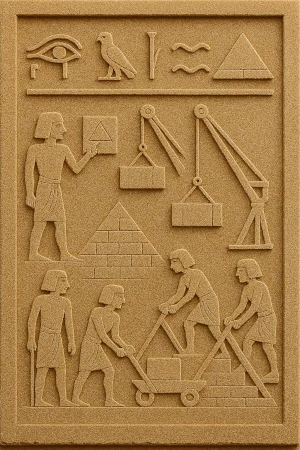
Let’s talk about the silence.
Not the desert silence. Not the wind across limestone silence. I’m talking about the visual silence. The absence. The gap that sits right in the middle of what should be the loudest visual archive in ancient history.
The pyramids are the most iconic structures ever built. They dominate documentaries, textbooks, conspiracy forums, architectural debates, engineering discussions, tourist fantasies. They are supposed to be the crown jewel of a civilization obsessed with carving its story into stone.
And yet when you go looking for the story of how they were built, carved in hieroglyphs, painted in relief, immortalized in grand narrative panels, you hit a wall.
Or rather, you don’t.
That’s the point.
If tens of thousands of men labored for decades dragging multi-ton blocks across desert causeways, if foremen barked orders under the blazing sun, if architects calculated alignments with obsessive precision, if the pharaoh stood proud watching the geometry of eternity rise before him, where are those scenes?
Where are the walls filled with them?
Where are the celebratory processions of masons, rope-pullers, stone-fitters, surveyors, priests blessing foundations, the sun god pouring light over the final capstone?
If the pyramids were the greatest engineering achievement of their time, and if Egyptian civilization carved almost everything of importance into stone, then why is this particular achievement visually underrepresented?
This isn’t a fringe question. It’s an obvious one.
Take the Giza Plateau. The site alone should have been a canvas. The Great Pyramid of Khufu wasn’t a backyard shed. It was the most ambitious construction project on Earth at the time. It required quarrying, transport logistics, labor organization, astronomical alignment, architectural planning on a scale that had never been attempted.
You would expect walls screaming with pride.
Instead, the interior of the Great Pyramid is almost completely bare. No dramatic reliefs. No triumph scenes. No king surveying the rising monument. No depiction of massive sledges dragging blocks across sand. No architect kneeling over a blueprint grid. Nothing.
Just stone.
Now let’s be precise. It’s not that ancient Egypt left no images of labor anywhere. There are scenes in private tombs showing farming, fishing, bread-making, cattle herding. There are later depictions of statue transport. There are New Kingdom tombs with brick-making and construction imagery.
But that’s not the same thing.
What we don’t see is a monumental, state-level, visually explicit celebration of pyramid construction itself during the Old Kingdom, the very era when these structures were built.
That’s the gap.
Some will immediately say, “That’s because pyramid interiors were never meant to be decorated.”
Fine. But that only shifts the question. If not inside the pyramids, then where are the surrounding temple complexes filled with such scenes? Where are the grand narrative panels in Old Kingdom temples proudly documenting the creation of these structures?
When you look at later Egyptian art, you see kings smiting enemies, offering to gods, receiving life from deities. You see ritual, theology, cosmic order. You see repetition of sacred motifs.
But you do not see a cinematic, detailed account of pyramid construction on the scale you would expect.
And this is not a trivial observation.
Consider how other civilizations documented major achievements. Roman emperors carved their victories into triumphal arches. Mesopotamian kings left reliefs of campaigns and building projects. Even later Egyptian rulers left inscriptions bragging about temples they erected.
Yet for the pyramids, the most jaw-dropping monuments of the ancient world, the visual boasting is strangely muted.
Yes, we have quarry marks. Yes, we have administrative papyri like the diary of Merer describing limestone transport. Yes, we have worker village remains near Giza. Yes, we have graffiti naming work gangs.
But these are fragments. Peripheral evidence. Administrative traces.
They are not grand visual narratives.
And that’s what bothers people.
Because when something is as visually dominant as the pyramids, the expectation is that the culture that built them would depict the process with equal dominance.
Instead, the Old Kingdom visual record emphasizes divine order. Ritual offering. The king in timeless poses. The afterlife. Cosmic journeys. Not project management. Not engineering logistics. Not thousands of workers sweating under the sun.
Some argue this makes perfect sense. Egyptian art was symbolic, not documentary. The king embodied cosmic order; he didn’t need to be shown supervising stone-cutters. The pyramid itself was the statement.
That explanation has merit.
But it doesn’t fully dissolve the tension.
Because Egyptians were not allergic to showing labor. They showed it in private tombs. They depicted craftsmen. They depicted agricultural work. They depicted even foreign captives performing hard labor in later periods.
So the idea that they simply “didn’t show work” doesn’t hold up.
They did.
Just not this work.
And that specificity matters.
If you walk through the tomb of Rekhmire from the New Kingdom, you see brickmakers, supervisors, materials being processed. You see activity. You see organization.
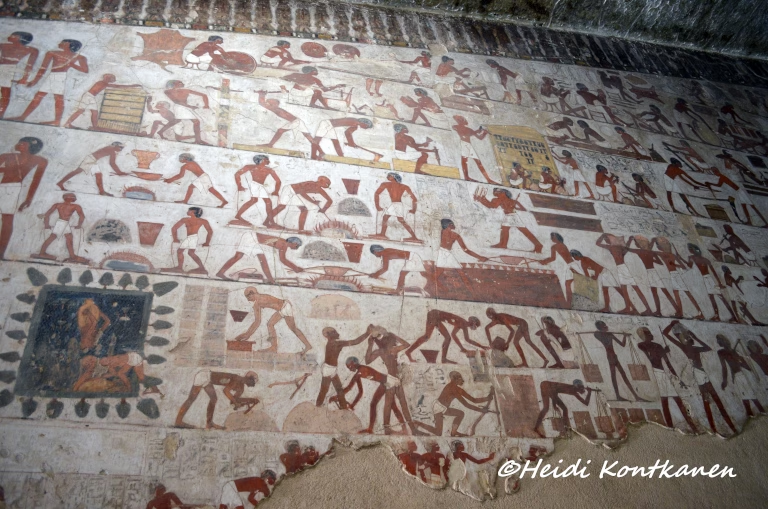
But that’s over a millennium after the Great Pyramid.
It’s a different era. A different ideological climate. A different artistic convention.
So the question remains anchored in the Old Kingdom.
Where are the thousands of depictions one would expect from a civilization that carved everything else into stone?
Some will say much was lost. Limestone reused. Reliefs destroyed. Pigments faded. Entire temple complexes dismantled by later rulers. That’s true. The archaeological record is incomplete.
But absence across the board? Across multiple pyramid complexes? Across multiple reigns?
It begins to look less like accidental loss and more like a consistent choice.
And if it was a choice, it’s worth asking why.
Perhaps pyramid construction was not seen as something to boast about visually. Perhaps it was a sacred duty, not a spectacle. Perhaps the king’s divinity was self-evident and didn’t require visual celebration of logistics.
Or perhaps the story was told in ways that do not survive — papyrus plans, wooden models, spoken ritual narratives long vanished.
But even granting all of that, the visual silence remains striking.
Inside the burial chambers themselves, the silence is even louder. The core pyramids of the 4th Dynasty are austere. No elaborate interior iconography. No narrative reliefs. No carved epics of their own creation.
When inscriptions do appear in later pyramids, they are spells — Pyramid Texts — not construction accounts. They focus on the king’s ascent to the heavens, union with the sun god, transformation into an eternal being.
The architecture is cosmic. The walls are theological.
But not historical.
And that distinction is everything.
If you’re expecting something akin to a Renaissance fresco cycle telling the story of creation, construction, and triumph, you won’t find it.
Not at Giza.
Not in Saqqara.
Not in the interiors of the 4th Dynasty pyramids.
Some have suggested maybe we’re looking in the wrong place. Perhaps the real depictions are in the Valley of the Kings.
But by the time the Valley of the Kings was in use, pyramid building as a royal practice had ended. The tombs there are rock-cut, hidden, heavily decorated with afterlife texts. They are cosmological manuals carved into stone.
Again — no pyramid construction narratives.
So you circle back.
The greatest monuments in the ancient world, built by a civilization that obsessively recorded ritual and divine order, lack large-scale visual documentation of their own creation.
That’s not conspiracy.
That’s an observable pattern.
Now, does this mean the pyramids weren’t built by Egyptians? No. That leap is unwarranted. Archaeology gives us worker settlements, tool marks, quarry evidence, transport records. The material record supports human construction.
But the visual record is thin where you might expect it to be thick.
And it’s okay to say that plainly.
We can acknowledge that Old Kingdom art prioritized eternal theology over earthly process. We can acknowledge that royal imagery emphasized timeless kingship rather than temporal labor. We can acknowledge that what survives may represent only a fraction of what once existed.
But we don’t have to pretend the absence isn’t curious.
Because it is.
The pyramids stand as massive, tangible proof of coordination, planning, human effort, engineering ambition. Yet the civilization that built them left us geometry instead of narrative.
Mass instead of murals.
Alignment instead of illustration.
You can interpret that as intentional abstraction. You can interpret it as sacred minimalism. You can interpret it as lost evidence.
What you cannot do, honestly, is point to walls covered in detailed Old Kingdom pyramid construction scenes and say, “There they are.”
They aren’t.
And that gap — between what we expect and what exists — is where the debate lives.
Maybe the Egyptians believed the structure itself was the depiction. Maybe the pyramid was the ultimate image, too sacred to reduce to carved storytelling. Maybe carving the process would have diminished the transcendence of the result.
Or maybe, in a civilization that measured time in eternity, the how simply didn’t matter.
Only the cosmic why.
Still, when you stand before those megalithic slopes at Giza and imagine the decades of labor that shaped them, it’s hard not to wonder why the story of that labor wasn’t carved somewhere in epic detail.
Not as a footnote.
Not as administrative scribbles.
But as a monumental narrative equal to the monument itself.
That’s the tension.
That’s the silence.
And until someone uncovers a hidden Old Kingdom relief wall filled with teams hauling blocks and architects sketching plans under the approving gaze of the sun god, that silence will remain part of the pyramids’ mystique.