

From Finding Pictures to Creating Them
There was a time when searching the web for an image was not something you could do with a few clicks. The internet was mostly a collection of text pages, directories, and primitive search engines trying to help people find information. If you wanted to see a specific photograph, product, person, or location, you usually had to know where to look first.
Today, that sounds almost impossible. We expect search engines to instantly show us thousands, sometimes millions, of images matching almost any query. Type a name, a product, a landmark, or even a vague description, and visual results appear immediately.
That convenience started 25 years ago when Google launched Image Search. To celebrate the anniversary, Google is looking back at how visual search changed the way people interact with the web while also introducing new AI-powered features designed for the next generation of search.
Of course, because this is Google in 2026, artificial intelligence is now becoming a central part of everything the company does.
The Jennifer Lopez Dress Changed Image Search
According to Google, the idea for Image Search came from one very specific moment: Jennifer Lopez wearing the famous green Versace dress at the 2000 Grammy Awards.

The dress became one of the most searched topics on the internet at the time. Millions of people wanted to see it, but they were not looking for a written description. They did not want an article explaining the dress. They wanted the image itself.
This was an important realization. Traditional search engines were built around words, but sometimes words were not enough. People were looking for something visual.
Google engineers understood that there was a gap between what users wanted and what search engines could provide. People were not always searching for information about something. Sometimes they simply wanted to see something.
The result was Google Image Search, which officially launched in July 2001 with an index of around 250 million images. Compared to today’s standards, that number seems tiny, but at the time it represented a major shift in how people explored the internet.
Twenty-five years later, image search feels like a basic feature of the web. Nobody thinks twice about searching for Jennifer Lopez’s green dress, a new car model, a travel destination, a product, or a design idea. Visual search has become so normal that it is easy to forget how different the internet was before it existed.
Google Images Is Moving Beyond the Search Box
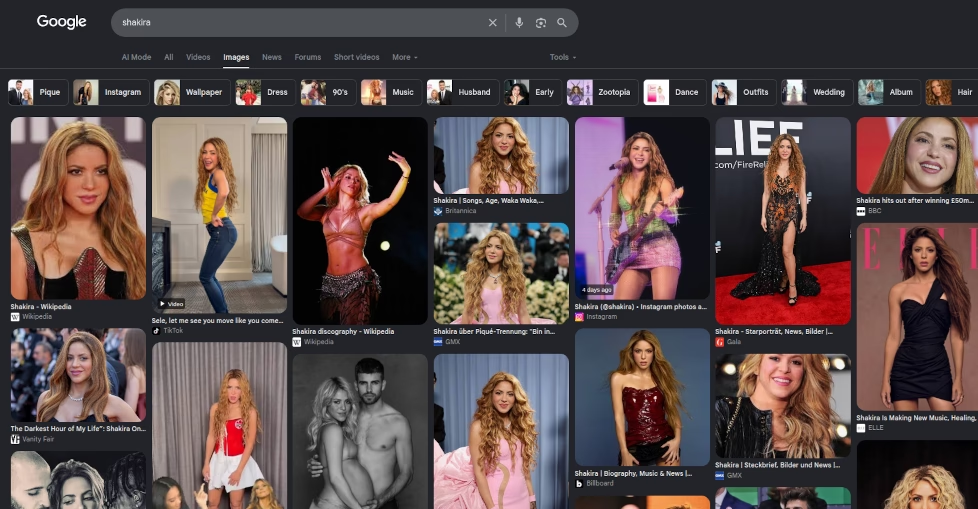
The current Google Images experience is still relatively simple. Open the page, type a query, and browse through image results.
That simplicity is actually refreshing in a web environment where many services have become overloaded with recommendations, notifications, menus, and AI features. Even Google’s main search homepage now includes multiple AI-related options and additional controls.
That is about to change.
Google is preparing a redesigned Image Search experience that will show users a visual gallery before they even type a search query. Instead of starting with a blank search box, users will immediately see a collection of images selected based on their interests.
This is a major change in philosophy. Traditional search starts with a question and provides an answer. The new experience starts by showing users content they might be interested in and encourages exploration.
The obvious question is how Google determines those interests.
The answer is user behavior. Google will use information from search activity and browsing patterns to personalize the image suggestions. The topics people search for, the content they interact with, and their overall activity across Google’s ecosystem will influence what appears in the new gallery.
Personalization has always been part of Google’s strategy, but this moves Image Search closer to the recommendation model used by platforms like social networks and streaming services.
Collections Are Returning as a Visual Bookmarking Tool
Google is also bringing more attention to Collections, a feature that many users probably have ignored.
Collections allow users to save images they find through Google Image Search and organize them for later. In theory, it works like a visual bookmarking system.
For example, someone planning a home renovation could save design ideas. A traveler could collect images of destinations, hotels, or activities. A business owner could save examples of branding, products, or marketing ideas.
The problem was never the idea itself. The challenge was visibility. Many users simply never discovered Collections or forgot that the feature existed.
With the new Image Search interface, Google plans to make Collections more prominent by placing saved items in a menu at the top of the main image gallery.
This fits with a larger trend across the internet. People are not only searching for information anymore. They are collecting ideas, comparing options, planning purchases, and building visual references.
AI Is Changing the Future of Image Search
The biggest change, however, is not only about finding images. It is about creating them.
Google is expanding AI-generated images directly into search results. Instead of only showing existing images from the web, Google can now create new images based on what users request.
The technology behind this comes from Google’s Nano Banana image model, which has already been available through Gemini and later expanded into AI Mode.
Now, image generation is becoming part of AI Overviews.
This means users will be able to ask Google for an image directly inside a search query. Instead of searching for an existing picture, they can request something that does not exist yet.
For example, someone could ask for a concept image, a design idea, an illustration, or a visual explanation of something. Google’s AI can generate the image and place it directly inside the AI Overview section of the search results.
This represents a fundamental change in how search engines work.
For decades, search engines acted as gateways to existing information. They crawled the web, indexed pages, and helped users find content created by others.
AI search introduces a different model. The search engine can now create content itself.
The Impact on Websites and SEO
For website owners, marketers, and SEO professionals, these changes are another reminder that search is evolving quickly.
Image Search was originally about helping users discover websites through visual content. A strong image could attract visitors, increase engagement, and generate traffic.
Now, Google is increasingly keeping users inside its own ecosystem. AI Overviews, generated images, and personalized recommendations all reduce the number of situations where users need to click through to external websites.
This does not mean websites become irrelevant. It means the value of being recognized as a trusted source becomes even more important.
Google’s AI systems need reliable information to generate answers and recommendations. Websites with strong expertise, clear branding, original content, and consistent entity signals have a better chance of being referenced.
The future of search is not only about ranking for keywords. It is about becoming a trusted source that search engines understand and users remember.
Google Image Search Enters Its AI Era
The first 25 years of Google Image Search were about organizing the visual web. The next phase is about combining discovery, personalization, and artificial intelligence.
The journey started with a simple problem: people wanted to see Jennifer Lopez’s green dress.
A quarter-century later, people are asking search engines to understand images, recommend visuals, save ideas, and even create new pictures on demand.
The search box that defined the early internet is slowly becoming something much bigger. Search is no longer just about finding information. It is becoming a system that predicts interests, creates content, and guides users through an increasingly visual web.
The challenge for businesses and creators will be adapting to a search environment where visibility depends not only on being found, but on being recognized as valuable by both humans and AI.